Suggesta 2.0
A clinically grounded homeopathic repertory by Massimo Mangialavori
A repertory built from clinical reality
Suggesta 2.0
-
The project began in 2008, with the first version launched in 2020.
Now in 2025, Suggesta 2.0 represents the culmination of over 40 years of clinical experience and insights from more than 11,000 patient cases — all documented through long-term follow-up where the prescribed remedy produced consistent results across both chronic disease and acute expressions.
- Get RadarOpus free trial!
- Check out RadarOpus packages and pricing.
Not a replacement — an accompaniment
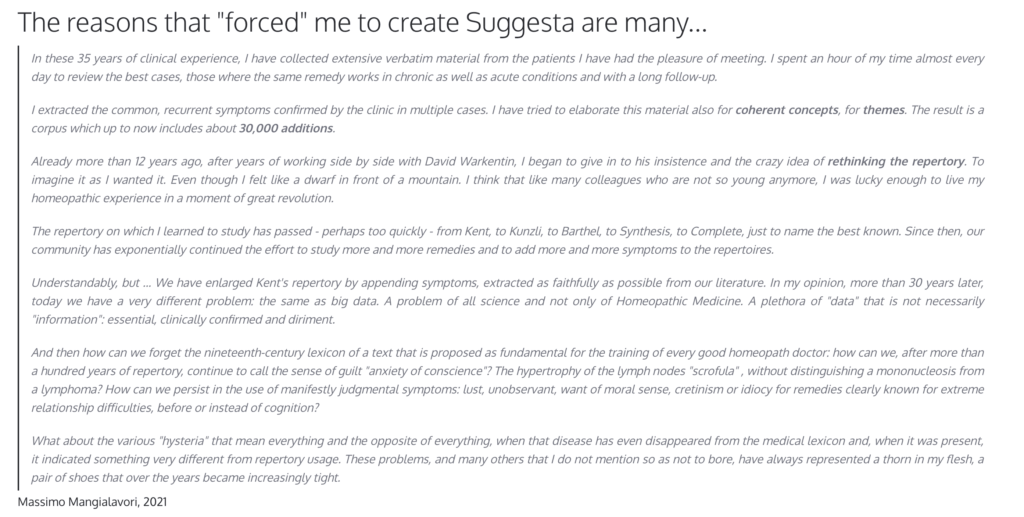
Suggesta 2.0 is not intended to replace the classical repertories. It is designed to accompany and enrich them — offering a consciously “biased” perspective based on the essential clinical vision of Dr. Mangialavori.
While it draws inspiration from the legacy of Kent, Suggesta departs in key ways: its structure, vocabulary, and content are all shaped by practical use rather than tradition alone. The goal is to make the study of the repertory more accessible, more clinically relevant, and more attuned to modern medical language.
What’s new in Suggesta 2.0
Suggesta 2.0 introduces a number of significant improvements and new features, informed by ongoing casework and the evolving needs of practitioners:
- Macro sections now in EnglishThe first version used Latin macro-headings. In Suggesta 2.0, all sections are now clearly labeled in English for easier navigation and understanding.
- New sectional structureRelated content is now grouped by symptom type, creating parallel tracks for:
- General symptoms
- Pains
- Illnesses/syndromes
For example: Bladder, Bladder Pain, and Bladder Illness are distinct, helping you locate relevant entries with greater precision.
- Updated Mind sectionThe Mind chapter has been refined to distinguish between fears and phobias.
- New Obstetrics sectionThis chapter explores symptoms related to conception, pregnancy, birth, postpartum, lactation, and puerperium, enriched by new clinical material from Dr. Mangialavori’s extensive database. The term “sterility” has been replaced with distinctions between infertility and reproductive challenges, reflecting a more contemporary lexicon.
- New and updated clinical materialPathologies and symptoms never before covered, such as bulimia and orthorexia, various forms of addiction (alcohol, different categories of drugs, medications, supplements), but also hypertension, hyperthyroidism, lupus erythematosus, sarcoidosis, etc.
- Terminological improvements throughoutExpect a more precise, modern vocabulary throughout — replacing judgmental or archaic phrasing with clear and medically accurate language.
Functional organisation and searchability
Suggesta is structured to support clinical logic, not simply alphabetical listing or legacy placement:
- Pains are grouped by their felt experience, not just anatomical location. For instance, a new heading Extreme suffering includes subtypes like Intolerable, Lacinating, Sawing bones, and Tearing.
- Cross-references and synonym systems enhance navigation and support flexible word search — especially within RadarOpus.
- Designed to work seamlessly with modern repertory software, Suggesta can be used alongside traditional tools while offering an upgraded search and structural experience.